Your exercise guide

Knee osteoarthritis exercises.
Step by step.

Explore simple exercises for your knees, hips and back. Explained step by step, with movement illustrations and exercise sheets for home.

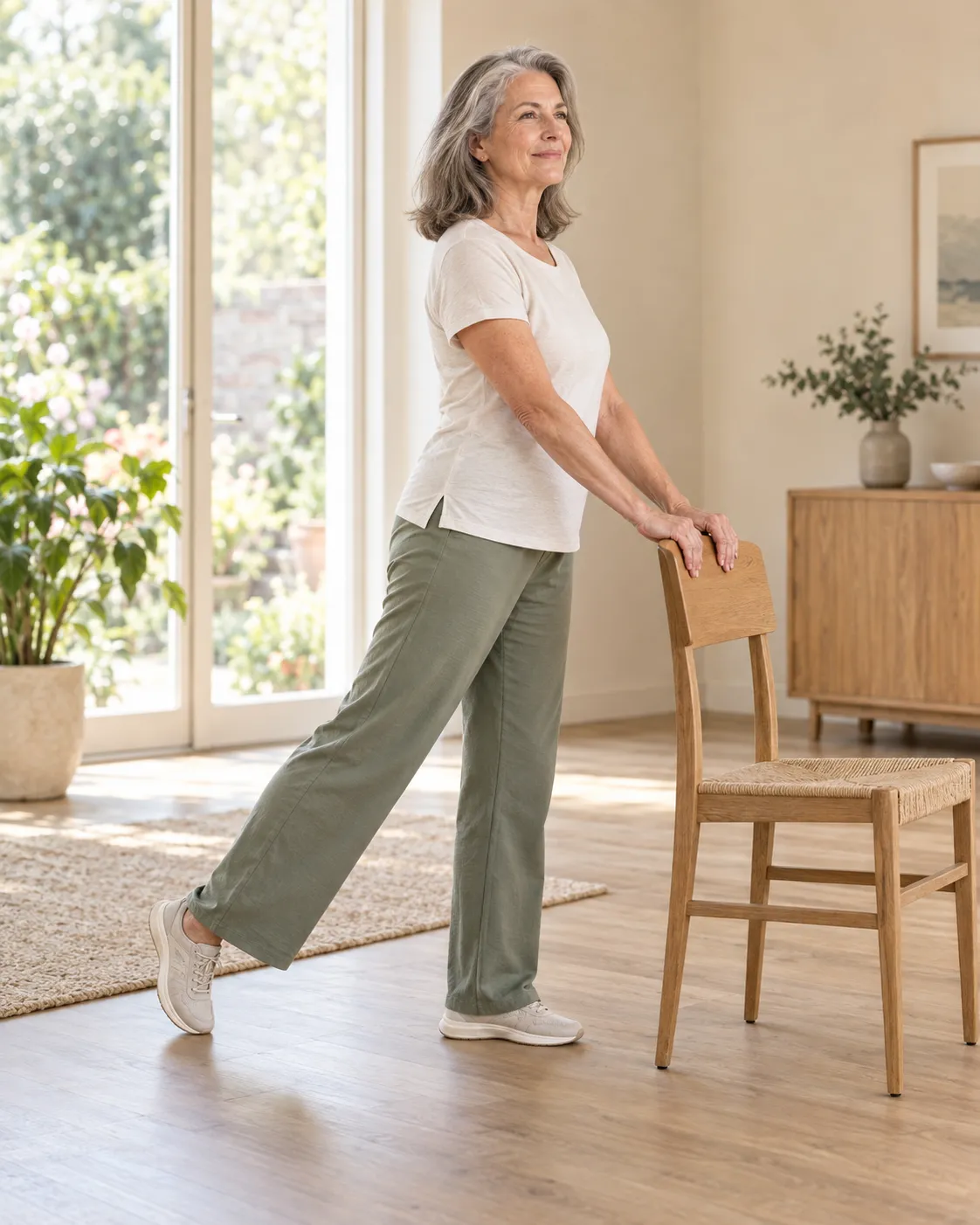
A woman practises a gentle standing movement at home, holding the back of a stable chair for support.

What would you like to do again in everyday life?

Your exercises at home

Small movements.
A place to start.

Nine exercises for your knees, hips and back. With pictures that show each step and exercise sheets to take with you.

Start well prepared.

Choose suitable exercises and the amount of exercise together with your clinical team or physiotherapist. The repetitions are a guide. Start slowly, without momentum, and within a comfortable range of movement. Use a firm chair without wheels and a non-slip surface.

When to pause

Stop the exercise and seek advice if pain is sharp, new or clearly increasing. After an operation, or if a joint is acutely swollen and hot, ask your treating team first.

Three exercises · A stable chair and a mat

For your knees.

Exercise sheet · KneesDownload PDF · German

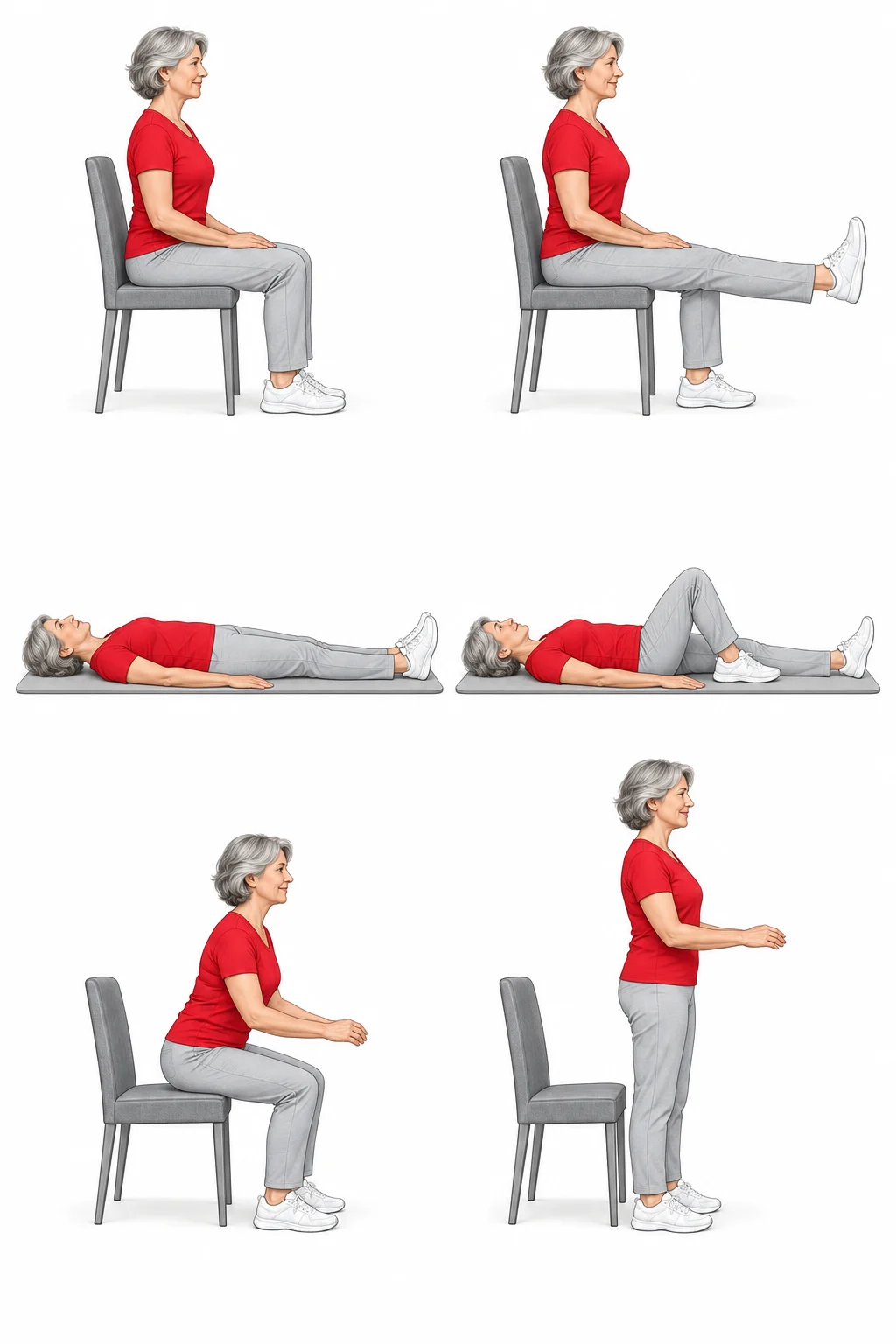
Sitting, lying down and standing up: three movements that are easy to explain and perform with attention.

01Seated
On the left, a woman sits upright with both feet on the floor. On the right, she straightens one knee while the other foot stays on the floor.
Starting positionMovement

Straighten your knee while seated

  1. Sit upright. Your thighs rest on the seat and both feet are on the floor.
  2. Slowly straighten one knee and pull your toes towards you.
  3. Hold for about 3 seconds. Lower your foot back to the floor with control.

Keep in mind: Keep your upper body upright.

Up to 10 repetitions on each side

02Lying down
A woman lies on her back. On the right, one heel slides towards her buttocks while the other leg stays straight.
Starting positionMovement

Slide your heel

  1. Lie on your back with your legs comfortably straight.
  2. Slide one heel along the surface towards your buttocks, bending your knee and hip.
  3. Slowly slide the heel back. Then change sides.

Keep in mind: Keep your heel on the surface.

Up to 10 repetitions on each side

03Using a chair
On the left, a woman sits towards the front of a chair and leans slightly forward. On the right, she stands upright in front of it.
Starting positionMovement

Stand up and sit down with control

  1. Sit towards the front of the chair with feet hip-width apart. Lean slightly forward.
  2. Slowly push up through your legs to stand, looking ahead.
  3. Stand upright, then sit down with control. Use your hands for guidance if needed.

Keep in mind: Make sure the chair cannot slip.

5 slow repetitions

Three exercises · A stable chair without wheels

For your hips.

Exercise sheet · HipsDownload PDF · German

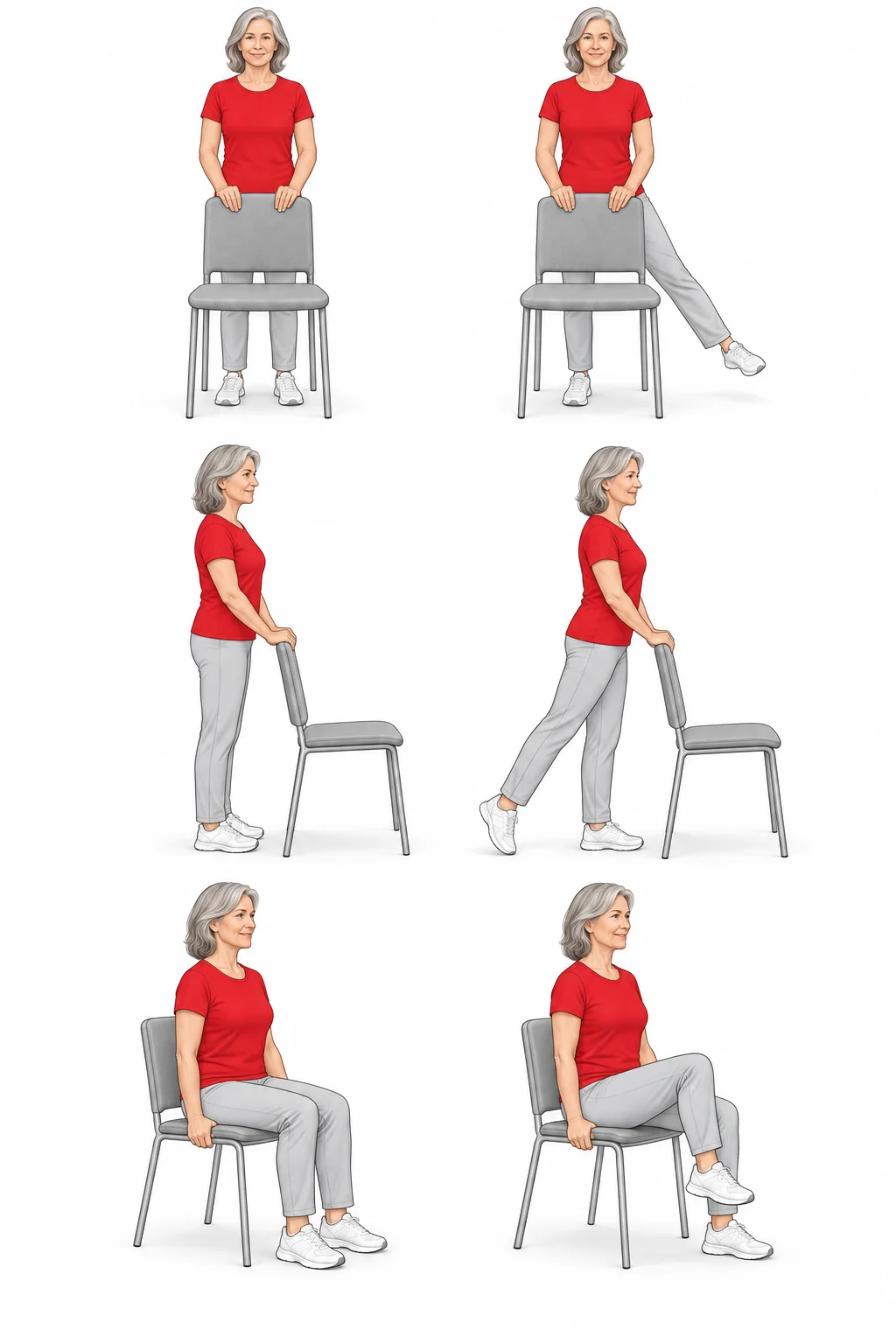
A chair provides support. Focus on a slow movement and an upright upper body.

01Standing
A woman holds the back of a chair. On the right, she lifts one straight leg to the side while keeping her upper body upright.
Starting positionMovement

Move your leg to the side

  1. Stand upright behind the chair, with both hands on the backrest.
  2. Slowly lift one leg to the side. Keep your pelvis and upper body level.
  3. Return your leg and change sides.

Keep in mind: Do not lean to the side.

5 repetitions on each side

02Standing
On the left, a woman stands upright by a chair. On the right, she moves one straight leg slightly backwards, keeping her hands on the backrest.
Starting positionMovement

Move your leg backwards

  1. Stand upright and hold the chair back with both hands.
  2. Move one straight leg a little backwards without arching your lower back.
  3. Hold for up to 5 seconds. Lower your foot and change sides.

Keep in mind: A small movement is enough.

5 repetitions on each side

03Seated
A woman sits upright and holds the sides of the seat. On the right, she lifts one bent knee while the other foot stays on the floor.
Starting positionMovement

Lift your knees while seated

  1. Sit upright without leaning against the backrest. Hold the sides of the seat.
  2. Lift one bent knee as far as is comfortable.
  3. Slowly put your foot down and continue with the other side.

Keep in mind: Keep your upper body still.

5 repetitions on each side

Three exercises · A comfortable, non-slip mat

For your back.

Exercise sheet · BackDownload PDF · German

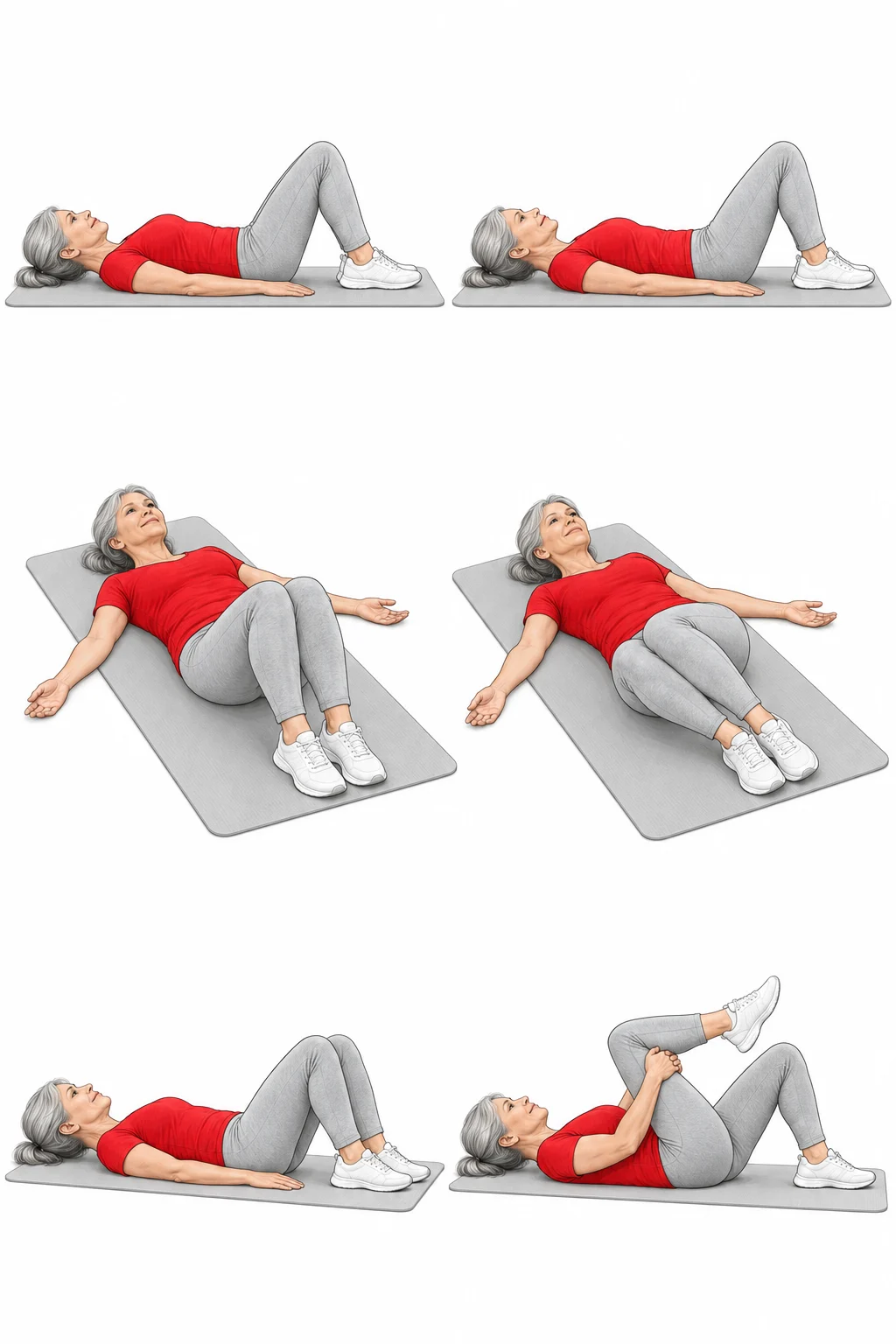
Three gentle movements on the mat. Take your time and keep breathing evenly.

01Lying down
A woman lies on her back with her feet on the floor. On the right, her lower back is slightly flatter while her pelvis remains on the mat.
Starting positionMovement

Gently tilt your pelvis

  1. Lie on your back, bend your knees and place your feet on the floor.
  2. Gently tilt your pelvis until your lower back lies flatter.
  3. Then tilt in the opposite direction, creating a small gap above the mat again.

Keep in mind: Use only a gentle tilt; do not lift your buttocks.

Slowly in both directions

02Lying down
On the left, a woman lies with her bent knees together. On the right, she lowers both knees slightly to one side while keeping her shoulders down.
Starting positionMovement

Roll your knees to the side

  1. Lie on your back. Bend your knees, keep them together, and place your feet on the floor.
  2. Slowly let both knees move a little to one side. Keep your shoulders resting on the mat.
  3. Return to the centre and move to the other side.

Keep in mind: Keep the range of movement comfortably small.

Gently from side to side

03Lying down
A woman lies with her feet on the floor. On the right, she brings one knee towards her body and holds behind the thigh; the other foot stays on the floor.
Starting positionMovement

Bring one knee towards your body

  1. Lie on your back with both feet on the floor.
  2. Bring one knee towards your body. Gently support it with both hands behind the thigh.
  3. Put the foot down again and change sides.

Keep in mind: Rest your head comfortably and do not pull on the knee.

One side after the other

Print & take with you

Your exercise guide.
On paper, too.

One sheet for each group, with three exercises, pictures and space for your personal exercise plan. These PDF sheets are currently in German.

Sources for the exercises

The movement instructions were compiled from these patient information resources. Texts and illustrations were created for this exercise guide. Content date: 22.09.2026.

General movement exercises, not an individual treatment plan. The back exercises do not imply any use of Crespine Gel in the spine.

More about movement and everyday life with osteoarthritis

Osteoarthritis can leave you feeling powerless: the cartilage is worn, nothing can change that, and treatment is in someone else’s hands. That is only part of the story. The best-supported part of osteoarthritis care is the part you do yourself.

This is not an empty reassurance. It is where the German S3 guideline is clearest — clearer than for any injection, including ours.

Movement

The guideline distinguishes between “we recommend” and the weaker “we suggest”. For exercise therapy, it states:

We recommend exercise therapy adapted to the individual needs of patients with knee osteoarthritis.

German S3 guideline 187-050, recommendation 34 · Translation from German

Start early

The guideline recommends starting regular strength and mobility training early, after receiving guidance. Early means before the joint starts to dictate your everyday life.

Begin with guidance, continue independently

The guideline suggests supervised exercise therapy. It then explicitly recommends continuing helpful exercises you have learned independently, with occasional reviews of the results.

Adapt the plan to you

Exercise therapy should suit individual needs. Which exercises fit you depends on your condition, your muscles and what you can keep up in everyday life.

What to know when starting

The guideline explicitly says patients should be told that joint pain can increase when starting exercise therapy — and that regular movement is still good for their joints.

Mild, temporary discomfort can occur at first. Sharp, new or clearly increasing pain is a reason to stop the exercise and seek advice. If a joint is swollen and hot during a flare-up, have it assessed by a clinician before continuing.

In the water

The guideline suggests aquatic exercise therapy to reduce pain, improve function and enhance quality of life. Water takes some of the body’s weight off the joint — for many people, the difference between a movement feeling impossible and manageable.

Weight

The guideline is unusually specific here. After recommending weight reduction for people who are overweight, it states:

Any weight loss towards a normal weight means less pain, better mobility and slower progression of osteoarthritis.

German S3 guideline 187-050, recommendation 9 · Translation from German

Any weight loss. Not only after losing ten kilos, and not only on reaching a normal weight. This may be the most effective measure on this page — and the hardest to put into practice.

Sport

The guideline recommends physical activity for people with knee osteoarthritis. At the same time, it recommends avoiding activities that place unnatural or excessive strain on the knee in everyday life, at work and in sport.

The distinction is between movement and overloading. Where that boundary lies is individual — something to discuss with your practice.

Walking aids and supports

Not everything offered for osteoarthritis is recommended. The guideline explicitly addresses three options:

We do not recommend routine use of shoe modifications or knee osteoarthritis braces.

German S3 guideline 187-050, recommendation 31 · Translation from German

The same applies to taping (recommendation 32). The guideline describes exceptions where exercise therapy alone has not been sufficient and there is significant joint instability or abnormal loading.

Walking aids are assessed differently: the suggestion to consider them for reducing load is supportive. A walking stick can provide relief.

Plan your exercises together

The guideline recommends learning exercises with guidance, then continuing independently. The pictures and sheets above help you remember the movements selected together with your care team.

  • Which exercises fit my everyday life?
  • How often and for how long should I exercise?
  • When should I seek advice again?

Write down the answers together with your treating practice or physiotherapist.

Questions to take with you

The appointment checklist has space for your questions. You can tick it and print it.

Open the printable questions

And injections?

This deserves an honest explanation, even where it does not favour us. For intra-articular hyaluronic acid, the German S3 guideline cannot make a recommendation because the evidence is conflicting. That differs from recommending against it, but it is not a recommendation in favour either.

The same guideline recommends exercise therapy. An injection does not replace your exercise programme. At most, it can be an addition.

Ask for a local contact

Source: German Society for Orthopaedics and Trauma Surgery, Prevention and Treatment of Knee Osteoarthritis, S3 guideline, AWMF register 187-050, version 5.0 of 15 July 2024. Quotations are our translations from German. This page does not replace a medical consultation or guidance from a physiotherapist.

Understanding your joints

Explore next

All videos

Your next step

Take your questions with you.

Use our checklist to collect the topics that matter to you. Tick, print and take it to your practice.

Prepare the conversationMore patient information